If you're evaluating strategy tools like Perdoo, Lattice Goals, Quantive (formerly Gtmhub), or Profit.co, you're trying to solve a real problem: your company has strategic goals, but the daily work doesn't seem to connect to them. Quarterly plans get made, people nod, and then everyone goes back to their inbox and task list.
A dedicated strategy tool sounds like the answer. A place where goals live, progress is tracked, and alignment is visible.
But here's what usually happens instead.
The promise: "One platform for your strategy. Set OKRs, track KPIs, align teams, and see progress in real-time."
The reality after 6 months:
The strategy tool didn't fail because it was bad software. It failed because it was another system — and the gap between systems is where strategy goes to die.
Dedicated strategy platforms make a structural assumption: that strategy management is a separate activity from work management.
They give you a place to define vision, set objectives, track key results, and run quarterly reviews. What they don't give you is a connection to the projects, tasks, clients, deals, and operational data that actually determine whether those objectives are met.
The result is two parallel universes:
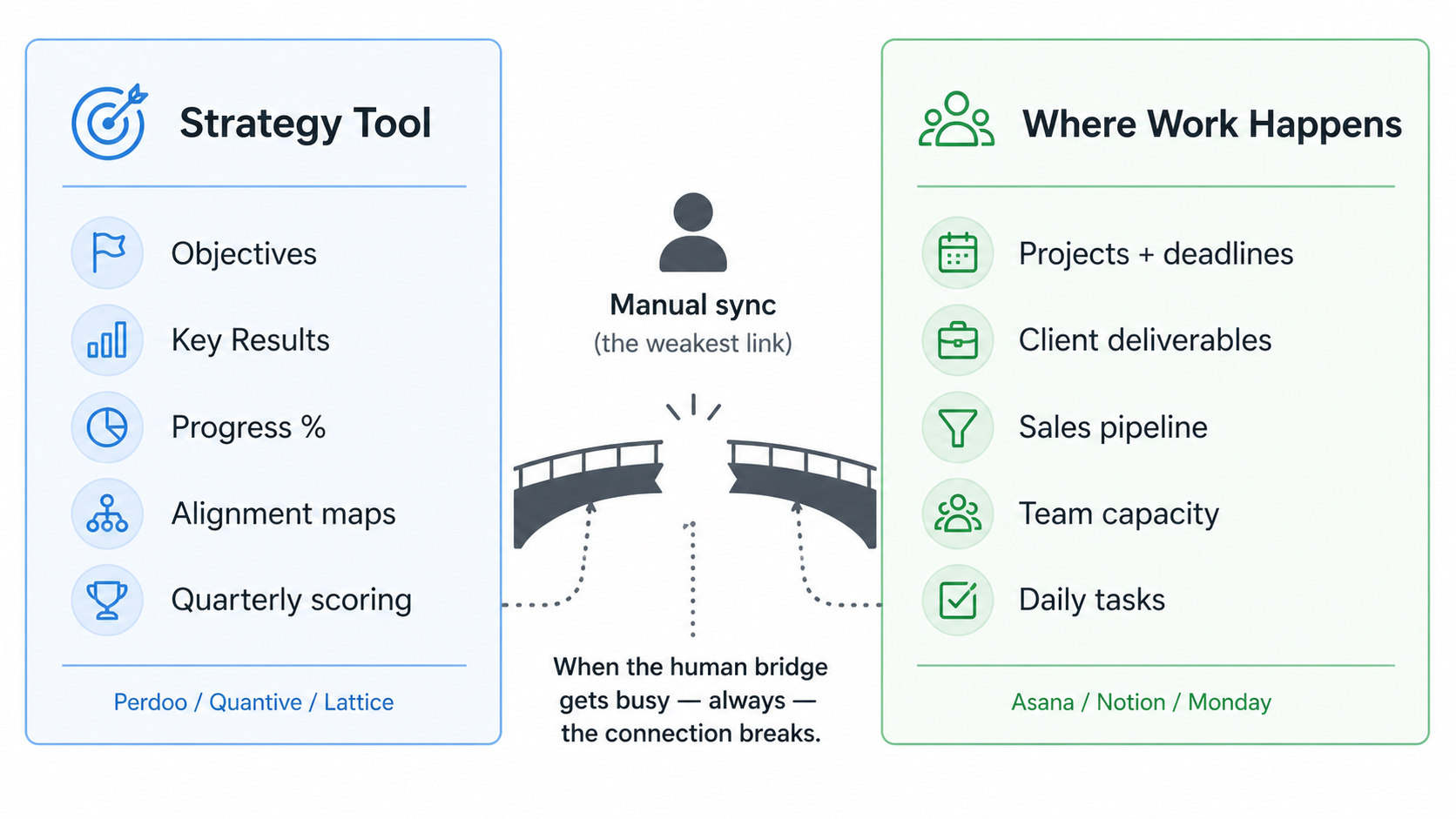
Universe 1 (Strategy tool):
Universe 2 (Where work actually happens):
The bridge between these universes is a human being who manually updates both. And that bridge collapses the first time someone gets busy — which is always.
In a dedicated strategy tool, someone updates Key Result progress by typing a number. "We're at 60%." Based on what? Their feeling? A quick mental calculation? Data from another system they checked this morning?
When KR progress isn't structurally connected to operational data, it's an opinion, not a measurement. And opinions decay: they're optimistic early in the quarter, panicked late in the quarter, and always slightly outdated.
In a connected system, progress comes from the data itself. If the Key Result is "Close 15 deals this quarter," the number comes from the pipeline — not from someone's memory of the pipeline.
Effective strategy execution depends on a weekly cadence: check the goals, check the work, identify gaps, adjust. This cadence only works if goals and work are visible in the same place.
When the strategy is in Perdoo and the work is in Asana (or Notion, or Monday), the weekly review becomes a context-switching exercise. Open tool A, review goals. Switch to tool B, review projects. Try to mentally connect them. Write notes in tool C.
Most teams give up within a month. The weekly check-in becomes a monthly check-in, then a quarterly ceremony, then nothing.
The most valuable part of the strategy cycle is the periodic review: what's working, what's not, what should change. But meaningful reviews require operational context.
"Key Result X is at 45% — are we on track?" The answer depends on: which projects support it, what's blocked, what resources are available, what the pipeline looks like, what changed since last month. None of this lives in the strategy tool.
So the quarterly review becomes a scoring exercise — "we hit this, we missed that" — instead of a strategic conversation about what to do differently. The review looks backward instead of driving forward.
The alternative isn't "no strategy tool." It's strategy management that's structurally embedded in the system where work happens.
This means:
Strategic directions live alongside the operational data they depend on. When you look at "Revenue Growth" as a strategic pillar, you can see the pipeline, the deals, the projects, and the KPIs — all in context, not in a separate tab.
Key Results are connected to real metrics. "Increase win rate from 25% to 40%" pulls its current value from the sales data. Nobody types a number. The number is the truth.
Projects explicitly support Key Results. When the team works on a project, they know which strategic goal it serves — because the connection is visible in their daily view, not buried in a strategy platform they open once a month.
Reviews are informed by operational reality. When it's time for a strategic review, the data is already there: which projects moved, which KPIs changed, which Key Results are on track, which are stuck. The conversation starts with facts, not with "let me pull up the numbers."
Regardless of what tool you use, effective strategy management needs three layers — and they need to be connected:
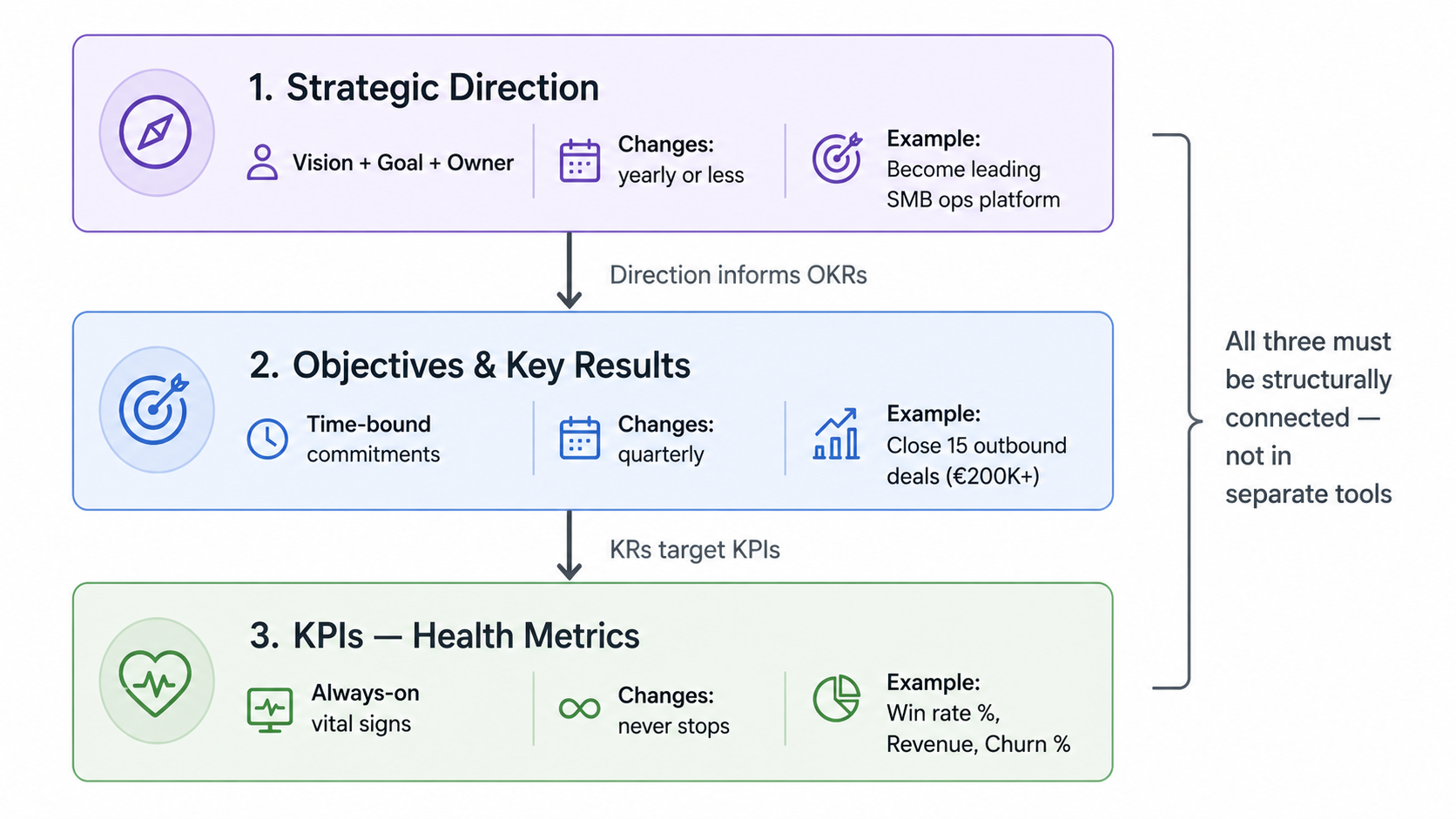
The big pillars: where is this company going? "Become the leading provider of X in the Y market." "Build a profitable recurring revenue model." "Create an operational foundation that scales to 100 people."
Each direction has:
This layer provides context and continuity. It doesn't change every quarter. It's the North Star that Objectives point toward.
The time-bound commitments: what are we trying to change this quarter?
Each Objective connects to a strategic direction. Each Key Result measures progress on the Objective. Each Key Result may target an ongoing KPI that it aims to improve.
This layer provides focus. 3–5 Objectives per quarter. Not more. The power is in what you choose NOT to pursue this quarter.
The vital signs: is the business healthy right now?
Revenue, margin, churn, win rate, delivery performance, budget utilization. These don't start and stop with quarters. They run continuously.
KPIs provide the baseline. When a KPI drifts out of its healthy range, it becomes a candidate for a new OKR. When a Key Result improves a KPI, the KPI confirms whether the improvement sticks.
The typical trajectory:
The fix isn't better tools at each layer. It's one system where all three layers are structurally connected — where clicking from a strategic pillar to its Objectives to their Key Results to the supporting projects takes three clicks, not three logins.
The most underrated element of strategy management is the periodic review. Not the annual offsite. Not the quarterly planning day. The regular, structured assessment of strategic progress.
An effective strategic review asks:
This isn't a retrospective. It's a decision-making engine. The output of a review isn't a report — it's new Objectives, adjusted Key Results, and reprioritized projects.
When this review is embedded in the same system where the work happens, it's fast. The data is already there. The context is visible. The decisions can be implemented immediately — not translated into another tool and communicated via email.
Dedicated strategy tools solve a real problem — but they create a new one: the gap between strategy and execution. The most effective approach isn't a better strategy tool. It's strategy management that lives inside the operational system, connected to the projects, metrics, and daily work that determine whether the strategy succeeds.
If you want strategy, KPIs, and daily execution in one connected system instead of three disconnected tools — explore how UniFrame integrates strategic direction with operational reality.


.jpg)
.jpg)