If you're searching why most Notion setups fail, it's probably because yours already has. The workspace started clean — a few databases, a dashboard, some clear intentions. Six months later: 40 databases, 12 unused views, and the team quietly went back to Slack messages and spreadsheets.
This isn't a Notion problem. It's a complexity creep problem. And the fix doesn't require rebuilding from scratch.
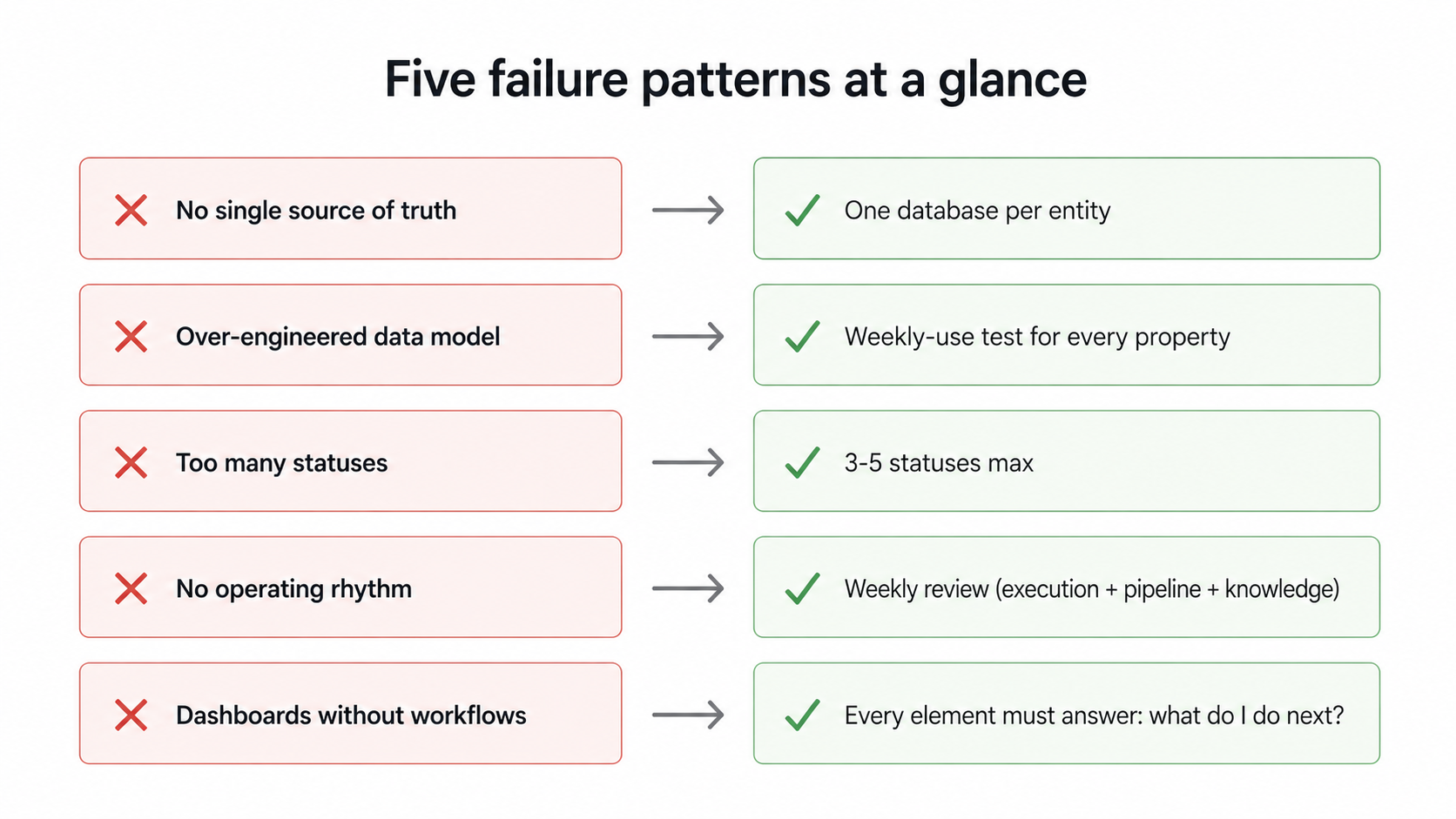
Symptom: The same information lives in three places. Someone asks "where's the project list?" and gets two different links.
Root cause: Databases were created reactively — one for this team meeting, one for that initiative, one for the dashboard. Nobody decided which database owns the concept.
Fix: One database per entity. Projects live in one place. Deals live in one place. SOPs live in one place. Everything else is a linked view of that same database. If you have two "Projects" databases, pick the better one and migrate. Today.
Symptom: Relations connect everything to everything. Rollups compute values nobody checks.
Root cause: Building for "what if we need this someday" instead of "what do we use this week." Every relation, rollup, and formula has a maintenance cost — and that cost compounds.
Fix: Apply the weekly-use test. Open each database and ask: "Which properties did someone actually look at or update in the last 7 days?" Everything else is a candidate for removal.
Symptom: The Status field has 9 options. Tags have 25 options. People spend more time categorizing work than doing it.
Root cause: The system was designed to describe work perfectly instead of moving work forward. Perfect categorization feels productive but isn't.
Fix: 3–5 statuses maximum. Tags only if they power a filtered view that someone opens weekly. "Nice to have" categorization is the enemy of adoption.
Symptom: Tasks pile up. The pipeline goes stale. "Active" projects haven't been touched in months. People say "I don't trust the data."
Root cause: The system was built for storage, not for running. Nobody installed a routine that forces data accuracy.
Fix: One weekly review that touches three things:
If the weekly review doesn't happen, the system decays. This is the single most important operational habit.
Symptom: Beautiful dashboards that look great in screenshots but don't drive action. People visit them once, say "cool," and never return.
Root cause: Dashboards were built to display, not to decide. A chart that shows "tasks by status" is information. A view that shows "tasks overdue with no assignee" is actionable.
Fix: Every dashboard element must answer one question: "What do I do next?" If it doesn't drive a specific action, it's decoration.
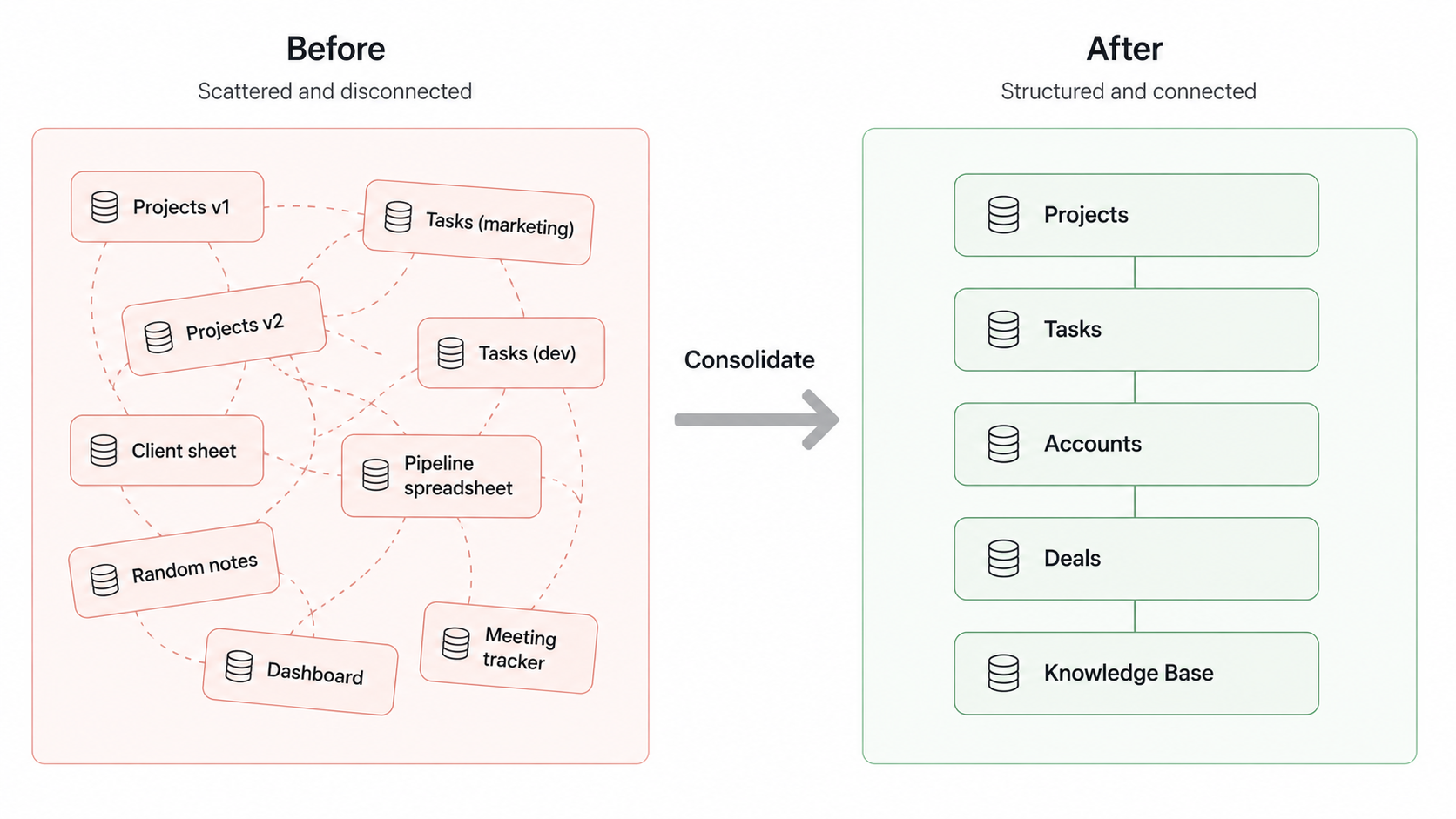
Rebuilding from scratch feels satisfying but usually recreates the same problems in a new layout. Instead:
Stop creating new databases, new views, new properties. Just stop. Use what exists for one week and notice what's actually missing vs. what you're used to adding "just in case."
What are the 3–5 databases your team would need if they could only keep five? Typically: Projects, Tasks, Accounts, Deals, Knowledge Base.
For every core entity, ensure there's exactly one database. Move pages from duplicates into the canonical one. Archive the rest.
In each core database, hide or delete:
Create views that surface problems:
These views are your early warning system. If they're empty, the system is healthy.
Notion setups fail when they're designed to describe reality perfectly. They succeed when they're designed to drive decisions weekly.
Every database, every property, every view should exist because it changes what someone does this week. Everything else is weight.
If you want a clean system without losing weeks to rebuilding — book a call to see how a structured reset works.


.jpg)