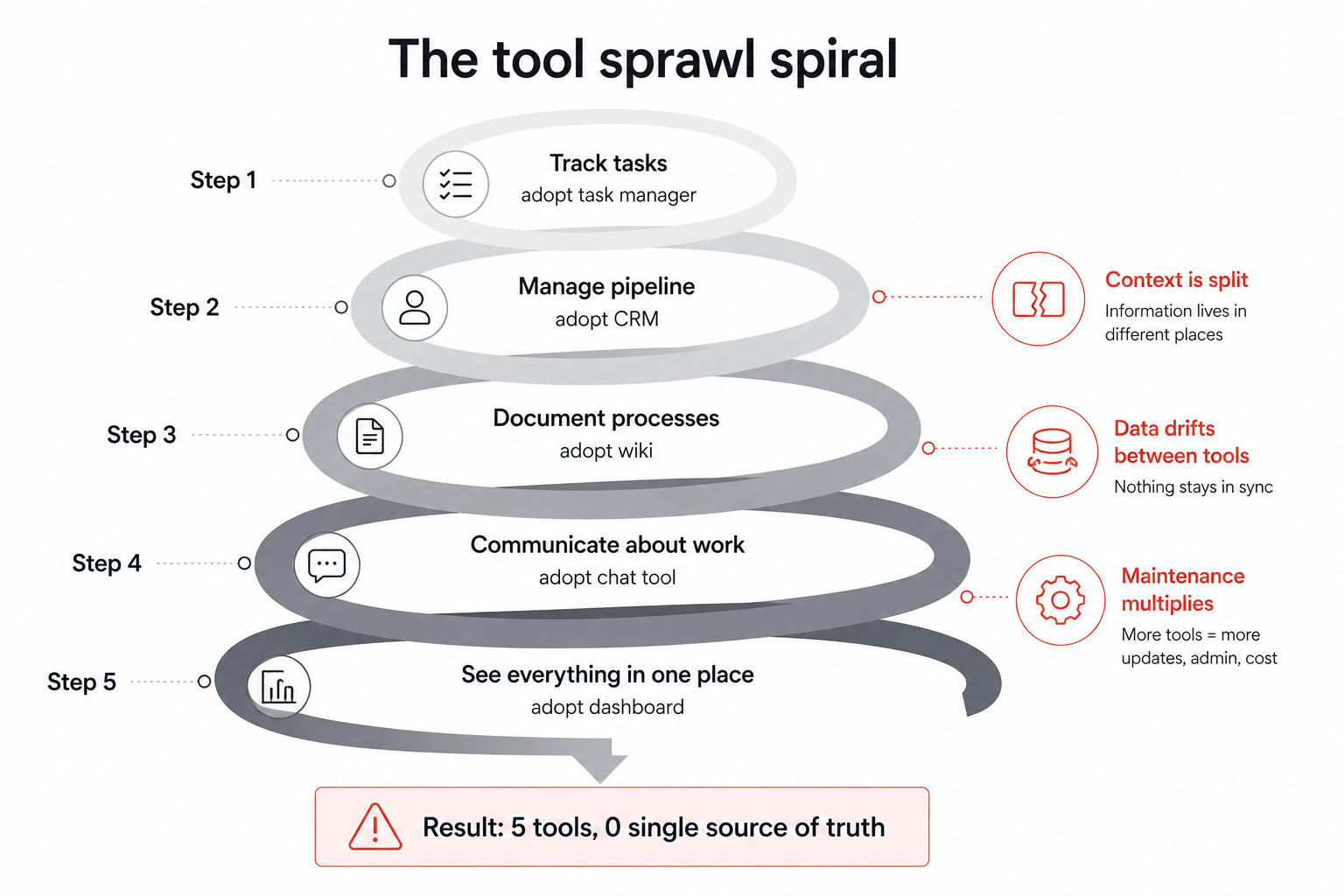
If you're searching you don't need more tools, you're likely living through the tool sprawl spiral: tasks in one app, documents in another, communication in a third, reporting in a spreadsheet, and a "dashboard" that's permanently outdated because it pulls from five sources that are never in sync.
Adding another tool to fix this doesn't work. You've already tried that. What works is structure — a small number of sources of truth, clear ownership, and workflows that don't depend on someone remembering to update three systems simultaneously.
Tool sprawl doesn't happen because teams are reckless. It happens because each tool solves a real, immediate problem:
Each decision is rational in isolation. But the compound effect is fragmentation:
Structure isn't a tool. It's a set of decisions:
1. One source of truth per entity.
Projects live in one place. Deals live in one place. SOPs live in one place. Not scattered across three apps with partial overlap.
2. One owner per outcome.
Every project has one person accountable. Every deal has one person responsible. Not "the team," not "whoever has time" — one name.
3. One workflow for how work moves.
Intake → Triage → Execute → Review. This sequence runs weekly. Everyone knows how work enters the system, how it gets prioritized, and how it gets closed.
4. One maintenance cadence.
A 30-minute weekly review that keeps data accurate. Without this, any system — even a perfectly structured one — decays within weeks.
You can implement this structure in Notion, or in another tool. The structure matters more than the tool.
Not every problem is a structure problem. Sometimes you genuinely need a specialized tool:
The test: Is this a tool that does something Notion structurally can't? If yes, use the specialized tool. If the tool just stores and displays data that could live in a database with the right structure — it's probably adding fragmentation, not value.
If you're already deep in tool sprawl, here's how to consolidate without losing anything important:
List every tool the team uses. For each one, write down: what data it holds, who uses it, and how often.
You'll find that 2–3 tools hold partially overlapping data. The task manager and the spreadsheet both track projects. The CRM and the spreadsheet both track deals. This overlap is where most confusion lives.
For each entity (Projects, Tasks, Deals, Accounts, SOPs), pick one place. That place becomes the source of truth. Everything else is either eliminated or becomes a read-only reference.
Don't migrate everything at once. Start with the entity that causes the most daily confusion (usually Projects or Deals). Build the database, migrate the data, run both systems for 2 weeks, then switch.
Don't just "stop using" the old tool. Set a specific date: "After March 15, the spreadsheet is no longer updated. The Notion database is the source of truth." Archive the old tool on that date.

The goal isn't one tool for everything. It's the minimum number of tools, each with a clear purpose and no overlap.
For most teams under 50 people, this looks like:
Everything else is a candidate for consolidation.
The magic isn't in the tool count. It's in having one clear answer to: "Where does X live?" If every team member can answer that question instantly for every entity — you have structure.
If you want to consolidate scattered tools into one operational structure — book a call to discuss how UniFrame approaches this.


.jpg)
.jpg)

