If you're trying to understand the strategy execution gap, here's how it usually shows up: the leadership team has a clear vision. There's a strategy document. Maybe even OKRs. And yet, when you look at what people are actually working on this week, most of it has no visible connection to any of those strategic priorities.
The CEO says "we're focused on revenue growth and operational efficiency." The team is working on a client deliverable, fixing a bug, updating a spreadsheet, and attending three status meetings. The connection between the two is assumed — but not visible, not tracked, and not maintained.
This is the strategy execution gap. And it's not a discipline problem. It's a structural one.
The gap doesn't come from lack of ambition or effort. It comes from the way most companies organize information:
Strategy lives at the top. A slide deck, an annual plan, a set of OKRs in a dedicated tool. Reviewed quarterly. Owned by leadership.
Work lives at the bottom. Task lists, project boards, client deliverables, daily standups. Reviewed weekly (or daily). Owned by the team.
Nothing connects them. There's no structural link between "Grow revenue 40%" and the 47 tasks someone is working on this week. The connection exists in people's heads — and it gets lost the moment priorities compete, capacity shrinks, or a new urgent request arrives.
The result: strategy is a quarterly conversation. Execution is a daily reality. And the space between them fills with improvisation.
Most companies think in two levels: "strategy" and "tasks." But the gap between a multi-year vision and a Tuesday to-do list is enormous. You need intermediate layers that translate direction into action.
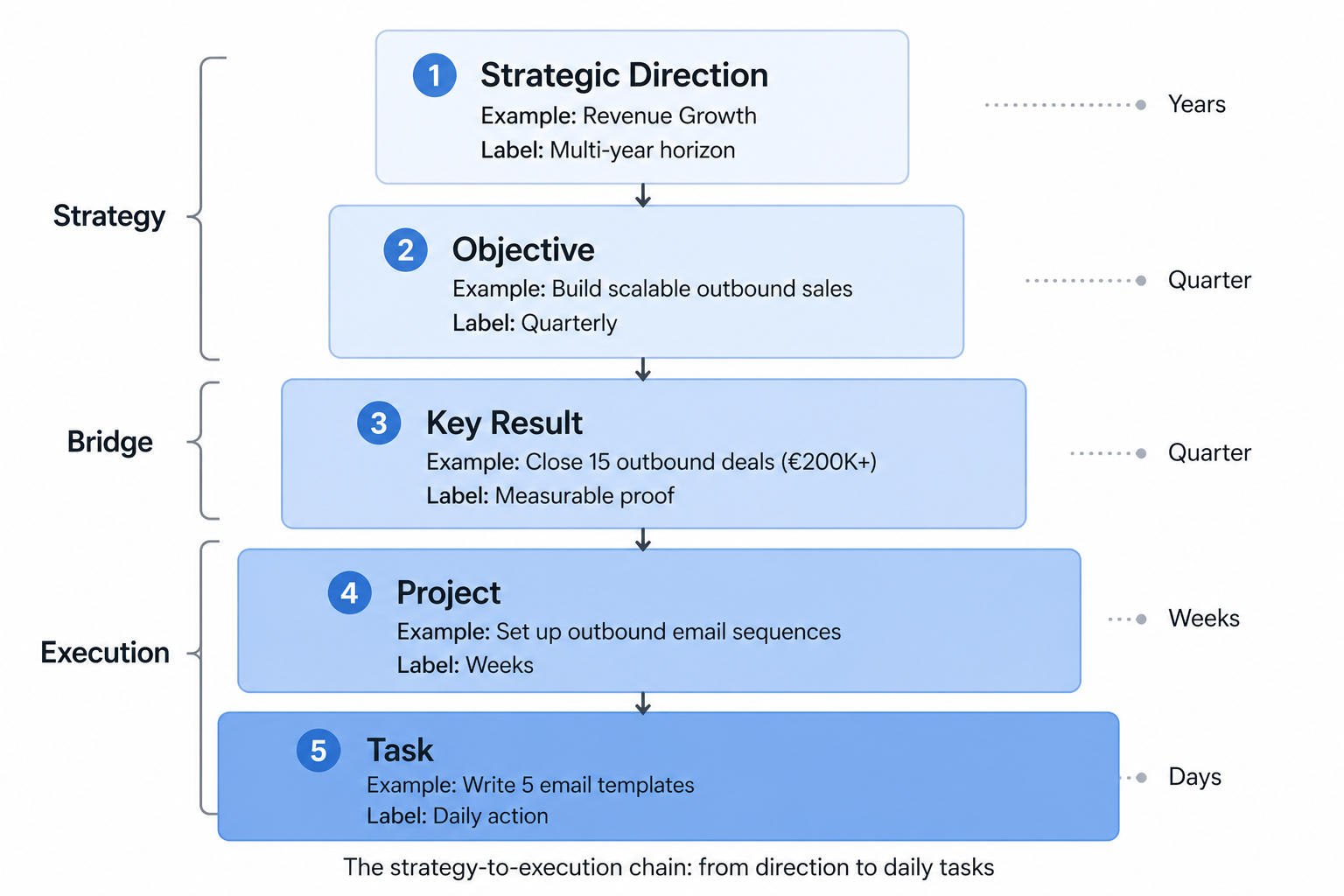
Here's what the full chain looks like:
This is the highest level: where is the company going and why?
A strategic direction has:
Most companies need 3–5 strategic directions. More than that means you haven't made choices — and strategy is fundamentally about choosing what NOT to do.
This layer provides the North Star. It answers: why does our daily work matter beyond the immediate deliverable?
This is the translation layer: what are we doing this quarter to move toward the strategic direction?
Objectives are concrete, time-bound initiatives. Not vague aspirations — actionable commitments.
Key Results are the measurable proof that the Objective is working:
Each Key Result has a start value, a current value, and a target. Progress is tracked weekly. Health is visible at a glance.
This layer provides focus and measurement. It answers: what specific changes are we pursuing right now, and how will we know if they're working?
This runs parallel to Layers 1 and 2. KPIs are the vital signs that tell you whether the business is functioning well, independent of any specific goal.
Revenue. Margin. Win rate. Churn. Cash flow. On-time delivery. Budget utilization.
KPIs don't have quarters. They're always on. They're compared over time (MoM, QoQ, YoY). They have health indicators and trend arrows.
The critical connection: Key Results often target specific KPIs. "Increase win rate from 25% to 40%" is a Key Result that directly references the Win Rate KPI. The KPI provides the baseline and ongoing tracking; the Key Result provides the time-bound improvement target.
This layer provides health awareness. It answers: regardless of our strategic goals, is the business functioning well right now?
The three layers above are the strategic structure. But strategy means nothing without execution. Here's where the chain reaches the daily work:
Key Results → Projects. Each Key Result is supported by one or more projects. "Close 15 outbound deals" might require projects like "Set up outbound email sequences," "Hire SDR," and "Build lead scoring model."
Projects → Tasks. Each project breaks into discrete tasks with assignees and due dates. "Write 5 email sequence templates," "Post SDR job listing," "Define lead scoring criteria."
The full chain:
Strategic Direction → Objective → Key Result → Project → Task
When someone opens their task list Monday morning, they can trace any task back to a strategic direction in three clicks. Not every task will be strategic (some work is maintenance, operations, or reactive) — and that's fine. But the strategic work should be visibly connected.
The most common break: strategy is set annually, but Objectives are set quarterly. The annual strategy document gets locked in a drawer. By Q3, nobody remembers what the strategic priorities were.
The fix: living strategic directions, not static documents. Strategic directions should be visible entities with owners, review dates, and linked Objectives — not a page in last year's slide deck. When it's time to set quarterly Objectives, the team opens the strategic directions and asks: "What should we do this quarter to move these forward?"
Teams set Objectives but write Key Results that measure activity instead of outcomes. "Launch 3 campaigns" instead of "Generate 500 qualified leads." The result: you can hit every Key Result and still fail to achieve the Objective.
The fix: every Key Result must have a number that moves. Start value, current value, target value. If you can't measure progress incrementally, it's a project milestone, not a Key Result.
Key Results exist. Projects exist. But nobody explicitly connects them. The team is busy with projects that feel important but don't support any Key Result. Meanwhile, Key Results stall because no project is actively driving them.
The fix: explicit project → Key Result linkage. Every project should know which Key Result (if any) it supports. Every Key Result should show which projects are driving it. If a Key Result has no projects, it's a wish, not a commitment.
Projects exist, but they accumulate tasks without prioritization. The project has 47 tasks, 12 are overdue, nobody is sure which ones actually matter. The project is technically "active" but effectively stalled.
The fix: project health is measured, not assumed. Completion percentage, overdue tasks, stale items — these should be automatically calculated and visible. An "active" project with 0% completion for 3 weeks isn't active. It needs a decision: reprioritize, descope, or cancel.
Structure without maintenance decays. The chain stays connected through a layered review cadence:

Weekly (30 min): Execution review
This is operational. It keeps the bottom of the chain clean.
Monthly (30–45 min): Strategic pulse
This is tactical-strategic. It catches drift before it becomes failure.
Quarterly (2–4 hours): Strategic review
This is the engine room. The output isn't a report — it's new commitments, adjusted targets, and reprioritized projects.
The strategy execution gap isn't closed by better planning. It's closed by better connections.
Annual planning doesn't fail because the strategy was wrong. It fails because the strategy isn't structurally connected to the quarterly goals, the quarterly goals aren't connected to the projects, and the projects aren't connected to the daily work.
Close those connections — make them visible, maintained, and reviewed — and the gap shrinks naturally. Not because people are more disciplined, but because the system makes the right work visible and the wrong work obvious.
The chain doesn't require perfection. It requires visibility. When a task can be traced to a strategic direction, people make better decisions about what to work on. When a Key Result has no supporting projects, the gap is obvious. When a KPI drifts, the connection to strategic goals provides context for the response.
If you want a system where vision, quarterly goals, ongoing metrics, and daily tasks are structurally connected instead of manually synchronized — explore how UniFrame bridges the strategy execution gap in one integrated operating system.


.jpg)