If you're searching why productivity systems don't work in real businesses, you've probably tried a few. Maybe a personal task manager that worked great for individual work but collapsed the moment two people needed to collaborate. Maybe a "business operating system" template that looked impressive but nobody on the team actually used.
The problem isn't the specific system. It's a category error: most productivity advice is designed for individuals managing their own time. Businesses need something fundamentally different — operational structure that handles shared work, handoffs, competing priorities, and accountability.
Productivity systems like GTD, time-blocking, or Pomodoro work because they solve an individual problem: "I have too many things to do and I need to decide what to do next."
But a business doesn't have one person making one decision. It has multiple people making interdependent decisions. And that changes everything:
A system designed for the left column will always fail when applied to the right column. Getting organized is not the same as building operations.
Personal productivity assumes you control your own priorities. In a business, priorities compete. The client project is urgent. The internal initiative is important. The CEO wants a report by Friday. And nobody has explicitly decided which comes first.
An operational system needs a prioritization mechanism that's visible to the whole team — not in someone's head, but in a view that everyone can see and reference when making trade-offs.
In individual work, you start and finish things. In business operations, work moves between people: sales hands off to delivery, delivery hands off to support, one team member finishes their part and another picks it up.
Every handoff is a potential failure point. Operational systems need to make handoffs explicit: who's passing what to whom, when, and what "ready for handoff" looks like.
Productivity systems have no concept of this. They assume work stays with one person from start to finish.
Most productivity approaches treat tasks as a list to be prioritized and executed. But business work has structure: tasks belong to projects, projects serve clients, clients have deals, deals follow a pipeline.
A flat task list can't answer: "Which project is at risk?" or "How much of this client's work is on track?" or "What's our pipeline forecast?" These questions require relational data — the ability to see how individual tasks connect to larger outcomes.
The dirty secret of every productivity system: it requires maintenance. Weekly reviews, inbox processing, priority resetting. Most individuals eventually stop doing this, and the system decays.
In a business, the stakes are higher. When the system decays, it's not just one person losing track of their to-dos — it's a team losing trust in shared data. And once trust is lost, people revert to Slack messages, email chains, and verbal agreements.
An operational system needs built-in maintenance rituals — a weekly review that's part of the operating rhythm, not an optional personal habit.
Instead of starting with "how do we get more productive?," start with "how does work flow through our company?"
This means building around four components:
Entities: What things do we track? (Projects, Tasks, Deals, Accounts, SOPs) Each gets one database, one source of truth.
Ownership: Who is accountable for each entity? One owner per project, one assignee per task, one owner per deal. No shared ownership, no "the team handles it."
Workflow: How does work move from request to completion? A clear flow: Intake → Triage → Execute → Review. Not a methodology — a practical sequence your team runs weekly.
Cadence: How often do we maintain the system? A weekly review that forces data accuracy: triage the inbox, confirm priorities, surface stale items, close completed work.
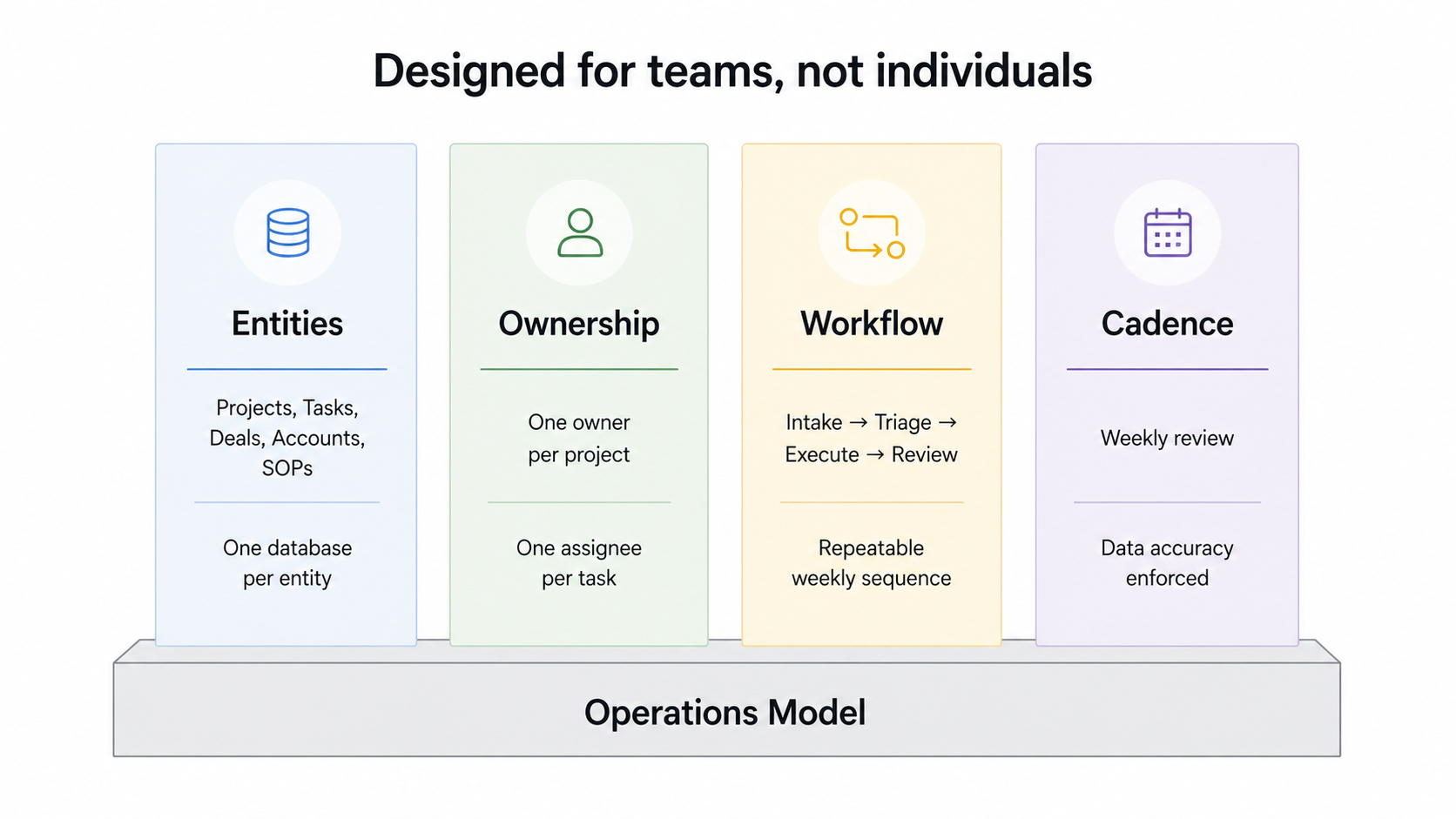
This isn't a productivity system. It's an operations model. The difference is that it's designed for teams with shared work, not individuals with personal to-do lists.
Ask yourself: does our current system answer these three questions at any moment?
If it can't, you have a productivity tool. If it can, you have an operational system.
If you want structure that survives team growth and priority changes — book a call to see how an operations-first approach works in practice.


.jpg)
.jpg)