If you're searching for KPIs vs OKRs, you've probably noticed that every explanation online makes it sound simple — and yet your team still can't agree on which one to use or how they relate to each other.
That's because most explanations treat them as alternatives: "use KPIs for this, use OKRs for that." But that framing is the root of the confusion. KPIs and OKRs aren't alternatives. They serve fundamentally different purposes — and most growing businesses need both, working together.
Here's the difference in one sentence:
A KPI tells you whether your business is healthy. An OKR tells you what you're trying to change.
KPI = thermometer. It measures the temperature. It doesn't change the temperature.
OKR = thermostat. "72°F (22°C) by the time I get home." A target, a gap, a deadline.
Your team = the heating system. The thermostat sets the goal — your people, projects, and daily decisions are what actually warm the room.
Your company's win rate is a KPI. "Increase win rate from 25% to 40% by Q3" is a Key Result inside an OKR.
Your monthly revenue is a KPI. "Grow monthly revenue from €50K to €80K by end of year" is a Key Result.
The KPI exists whether or not you have an OKR about it. The OKR exists because you decided that specific KPI needs to improve.
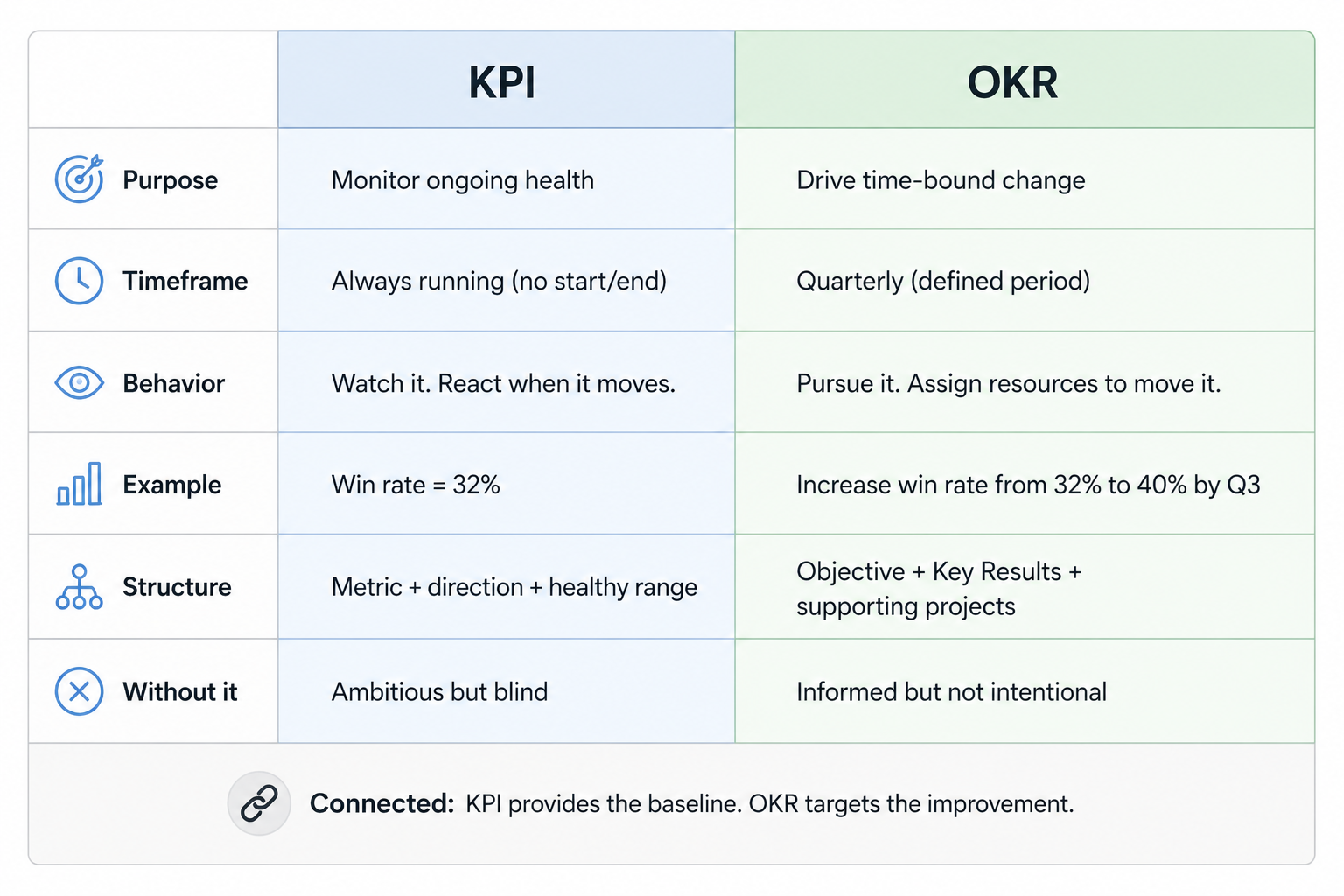
Three reasons teams mix these up:
Both involve numbers. Both get reviewed. Both appear on dashboards. So people naturally assume they're the same thing with different names.
But the behavioral intent is completely different:
Monitoring and pursuing are fundamentally different management activities. Conflating them means you either over-invest in metrics that just need watching, or under-invest in goals that need active work.
Most dedicated OKR platforms (Perdoo, Quantive, Lattice Goals) focus on the goal-setting cycle: define objectives, set key results, track progress, score at end of quarter.
Most KPI dashboards (Databox, Geckoboard, or a custom spreadsheet) focus on real-time metrics: current values, trends, comparisons.
Because the tools are separate, the concepts feel separate. Teams end up with a KPI dashboard nobody checks and an OKR tool nobody updates — two half-solutions instead of one connected system.
In many organizations, "KPI" has become a generic term for "any number we care about." Quarterly targets, annual goals, operational metrics, project milestones — they all get called KPIs.
This linguistic sloppiness has real consequences. When everything is a KPI, nothing has a clear purpose. The team can't distinguish between metrics to watch and goals to chase.
A KPI (Key Performance Indicator) is an ongoing metric that reflects the health of a business function. It has these characteristics:
Examples of real KPIs:
Notice: none of these have a target built in. They're measurements. You can add targets to them (and you should) — but the metric exists independently of any goal.
An OKR (Objective and Key Result) is a time-bound commitment to improve something specific. It has these characteristics:
The team monitors metrics religiously. Revenue is tracked. Win rate is known. Churn is measured.
But nothing deliberately improves. The numbers fluctuate. When revenue dips, there's a reactive scramble. When win rate drops, someone investigates. But there's no proactive, focused effort to move specific metrics in a specific direction.
The symptom: The team is informed but not intentional. They know what's happening but aren't actively shaping what happens next.
The team sets ambitious quarterly goals. "Grow revenue 50%." "Launch three new products." "Expand into two new markets."
But they don't track the underlying health metrics continuously. They hit the revenue target — but didn't notice that margin dropped to 5% because they were discounting to close deals. They launched three products — but didn't see that existing customer churn doubled because support was neglected.
The symptom: The team is ambitious but blind. They chase goals without seeing the side effects.
The most common failure mode. KPIs live in a dashboard. OKRs live in a separate tool. The KPI dashboard shows churn is rising. The OKR tool has a Key Result about reducing churn. But they're not connected — so the team discusses churn in two separate meetings with two separate datasets and no shared context.
The symptom: Duplicate conversations, conflicting data, and the feeling that "we track too many things but still don't have clarity."
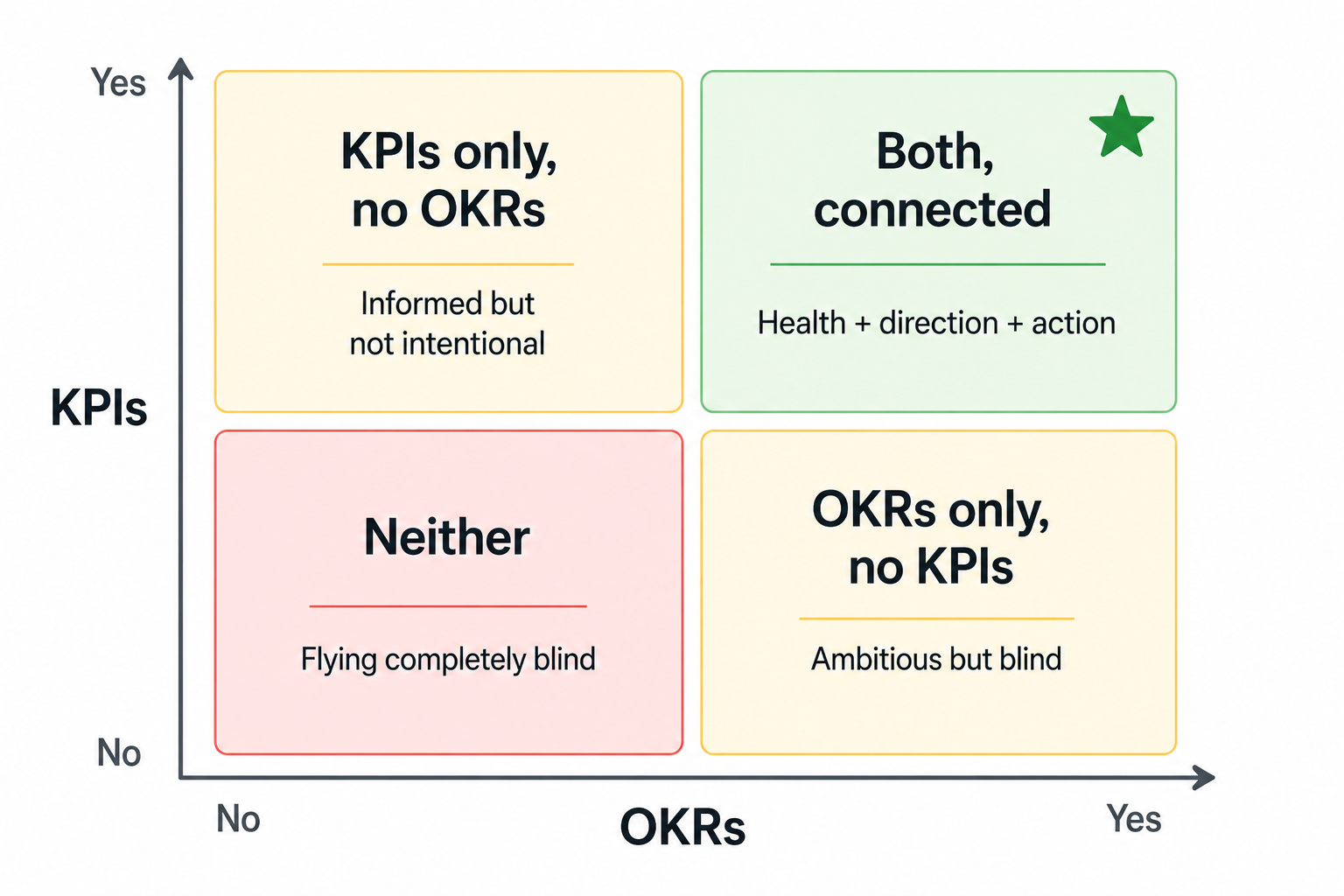
The KPI is the ongoing signal. The OKR is the deliberate response.
When a KPI turns unhealthy (churn rising above 5%), that becomes the basis for a new OKR: "Reduce churn from 8% to 4% by Q3."
When an OKR is achieved (win rate improved to 40%), the KPI confirms whether the improvement holds over time — or was a one-quarter anomaly.
The KPI provides context. The OKR provides focus. Together, they create a system where leadership can see both "how healthy are we?" and "what are we deliberately trying to change?"
Use this simple test:
"Is this something we need to watch continuously, or something we need to actively improve this quarter?"
For most growing companies, the KPI board has 10–15 metrics. The quarterly OKR set has 3–5 Objectives with 2–4 Key Results each. Only some KPIs have active Key Results targeting them in any given quarter — and that's exactly right. You can't improve everything simultaneously.
Not every company needs the same KPIs or the same OKR structure. Here's a rough guide:
Early stage (1–10 people):
Growth stage (10–50 people):
Scale stage (50+ people):
KPIs and OKRs aren't competing frameworks. They're complementary layers of the same management system:
If you want KPIs and OKRs that work as one connected system instead of two separate reporting exercises — explore how UniFrame integrates both into a single operational model.


.jpg)
.jpg)