If you're searching for how to track OKRs without drowning in process, you've probably already experienced the cycle: the leadership team runs an enthusiastic quarterly planning session, everyone writes ambitious Objectives and Key Results, they go into a spreadsheet or a dedicated tool — and six weeks later, nobody updates them until the next planning session.
The problem isn't OKRs as a framework. The problem is how most teams implement them: as a reporting layer that sits on top of work, instead of a structure that's woven into how work actually happens.
This guide breaks down what makes OKR tracking sustainable — and what turns it into administrative theater.
The failure pattern is remarkably consistent across companies of every size:
Quarter 1: High energy. The team spends a full day defining Objectives and Key Results. Everything gets documented. Weekly check-ins are scheduled. People are optimistic.
Quarter 2: Updates become sporadic. The weekly check-in gets cancelled "just this once" and never returns. Key Results haven't been updated in three weeks. Nobody is sure whether the numbers are current.
Quarter 3: The spreadsheet is abandoned. Someone suggests "maybe OKRs aren't for us." The team goes back to working without explicit strategic alignment — which is exactly where they started.
The root cause is always the same: OKRs were implemented as an additional reporting burden, not as a structural part of how work is organized.
When updating OKRs requires opening a separate tool, remembering to log progress, and translating work into a different format — it won't survive. People are busy. Extra admin dies first.
This is the most common and most fatal mistake. The team's daily work happens in a project management tool. OKRs live in a spreadsheet, a Perdoo account, or a separate Notion page.
The result: two systems that drift apart. Projects move forward, but nobody updates the Key Results. Key Results get discussed quarterly, but nobody connects them to the tasks being done this week.
The fix: OKRs must live in the same system where projects and tasks are managed. Not as a separate layer — as a connected part of the same structure. When a project moves forward, the Key Result it supports should reflect that progress without someone manually copying numbers between tools.
The second most common mistake: writing Key Results that describe what you'll do instead of what will change.
"Launch the new website" is an activity. "Increase organic traffic from 5,000 to 15,000 monthly visits" is an outcome.
"Hire 3 sales reps" is an activity. "Close 20 new deals worth €500K total" is an outcome.
Why does this matter? Because activity-based KRs are binary — you either did it or you didn't. There's nothing to track over time, no partial progress, no early warning that you're off track. Outcome-based KRs have a starting value, a current value, and a target — which means you can see trajectory, not just completion.
The fix: Every Key Result should have three numbers: where you started, where you are now, and where you're trying to get. If you can't express it with these three numbers, it's either a project (not a KR) or it needs to be reframed.
Most teams treat OKRs as if they exist in isolation. But Key Results don't appear from nowhere — they're almost always about improving a metric that the business already tracks (or should be tracking).
"Increase win rate from 25% to 40%" — win rate is an ongoing KPI. The Key Result is a time-bound improvement target on that KPI.
"Reduce customer churn from 8% to 4%" — churn rate is an ongoing KPI. The Key Result is a quarterly push to improve it.
When OKRs aren't connected to the metrics they're supposed to move, two things happen: you can't see whether the improvement is actually happening in real operations, and you can't see whether the improvement sticks after the quarter ends.
The fix: Each Key Result should explicitly reference the ongoing metric it aims to improve. This creates a feedback loop: the KPI shows current reality, the Key Result defines the target, and the gap between them is what the team is working to close.
Forget the quarterly ceremony for a moment. Here's what OKR tracking looks like when it's working:
The structure has natural layers:
Strategic direction — the long-term pillars your company is focused on. These don't change quarterly. "Become the market leader in SMB operations" is a direction. It might take 2–3 years. It has a qualitative vision (where you want to be) and a quantitative goal (the number that proves you're there).
Objectives — quarterly initiatives that move the needle on one strategic direction. "Build a scalable outbound sales motion" is an Objective. It's concrete, time-bound, and clearly connected to the strategic direction.
Key Results — measurable outcomes that prove the Objective is progressing. "Close 15 outbound deals" and "Achieve 30% response rate on cold outreach" are Key Results. They have numbers. They're tracked.
Projects and tasks — the actual work that delivers the Key Results. "Set up email sequences," "Hire SDR," "Build lead scoring model" are projects that support specific Key Results.
The chain is: Direction → Objective → Key Result → Project → Task.
When someone is working on a task Monday morning, they should be able to trace it back to a strategic direction in under 30 seconds. If they can't, either the task isn't strategic work (which is fine — not everything is) or the chain is broken.
Not all Key Results are created equal. One of the most useful distinctions (borrowed from Google's OKR practice) is between committed and aspirational Key Results:
Committed KRs are targets you expect to hit. Missing them signals a planning or execution failure. "Process 100% of invoices within 48 hours" — this should happen.
Aspirational KRs are stretch goals. Hitting 70% is considered success. "Grow ARR from €200K to €1M" — this is ambitious by design.
Why does this distinction matter? Because without it, teams either sandbag (setting easy targets to always hit 100%) or get demoralized (setting stretch targets and feeling like they failed at 70%). Labeling the ambition level upfront sets the right expectations for evaluation.
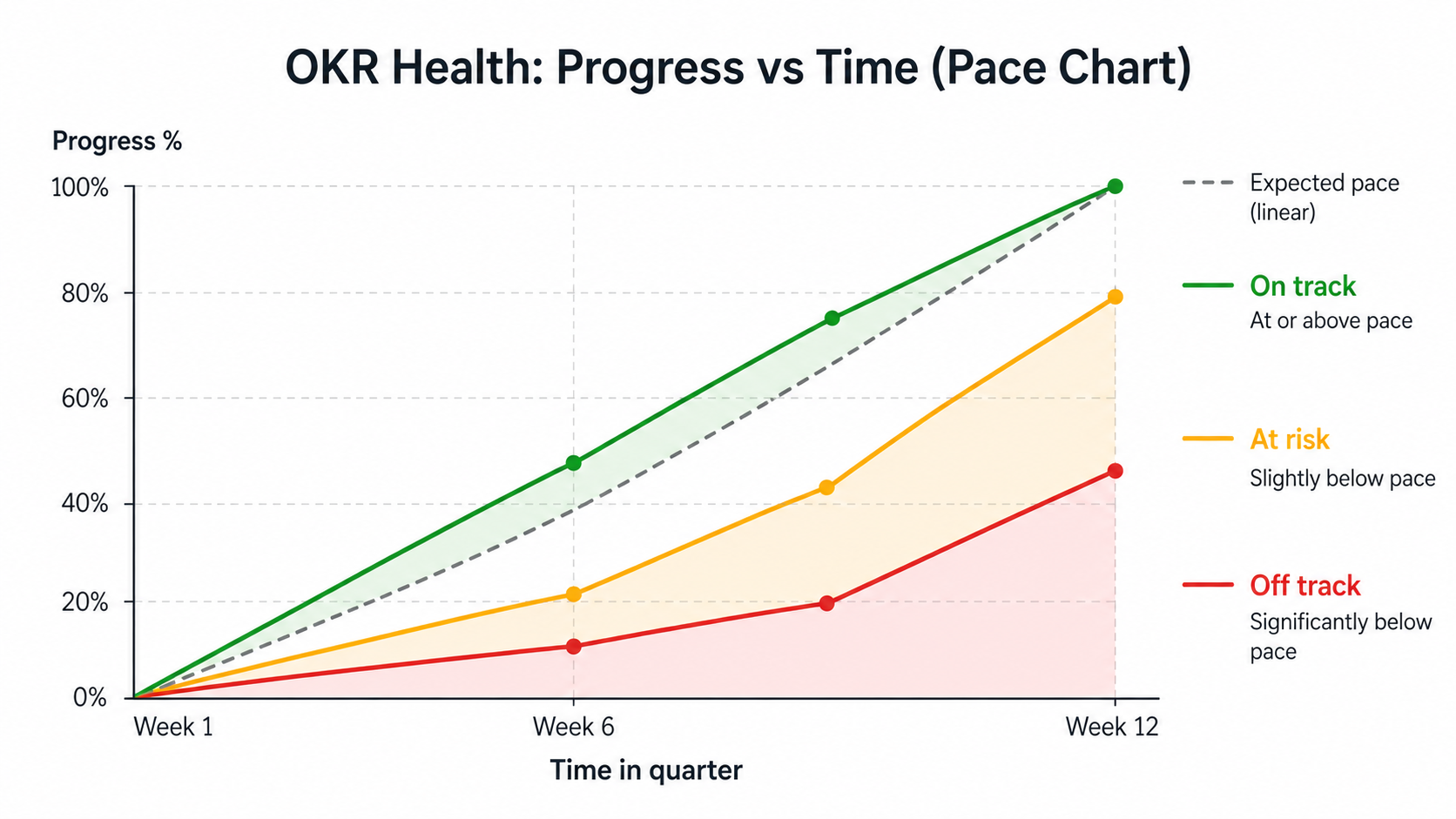
A percentage alone doesn't tell you whether a Key Result is on track. 50% progress at the halfway point is fine. 50% progress with one week left is a problem.
Effective OKR tracking uses health indicators that combine progress with time:
These indicators should be visible at a glance — not buried in a detailed view that nobody opens. When leadership reviews OKRs, the first thing they see should be a wall of green, yellow, and red. The conversation starts with the red items.
The single most important factor in OKR success is the review cadence. Not the quarterly planning session — that's just the starting point. What matters is what happens between planning sessions.
During the regular weekly team review (which you should already have for operations), spend 5 minutes on OKRs:
This isn't a deep discussion. It's a pulse check. If something is off track, schedule a separate conversation.
Once a month, zoom out:
The quarterly cycle isn't just "set new OKRs." It's a structured review:
The review creates a feedback loop. Without it, OKRs become a forward-only exercise: plan, execute, forget, repeat. With it, each quarter builds on the last.
One of the biggest sources of OKR bloat is tracking things that shouldn't be OKRs:
The reason dedicated OKR tools (Perdoo, Quantive, Lattice) often fail isn't that they're bad products. It's that they create a parallel universe. The strategy lives in one tool. The work lives in another. And the human bridge between them — someone manually updating both — is the weakest link.
The most effective OKR implementations we've seen share one characteristic: the OKRs live where the work lives. When a project is completed, the Key Result it supports reflects the progress. When a KPI changes, the Key Result tracking that KPI updates. When the team opens their Monday view, the strategic context is visible alongside the tactical tasks.
This isn't about a specific tool. It's about a design principle: strategy and execution must be structurally connected, not manually synchronized.
If you want OKRs that survive past the first quarter and actually drive execution — explore how UniFrame connects strategic goals to daily work in one integrated system.


.jpg)
.jpg)