If you're searching how to reduce manual work with a structured system, you're probably not talking about the work itself — you're talking about the coordination around the work. The follow-ups, the status pings, the "did anyone handle this?" messages, the meetings that exist only because nobody trusts the task list.
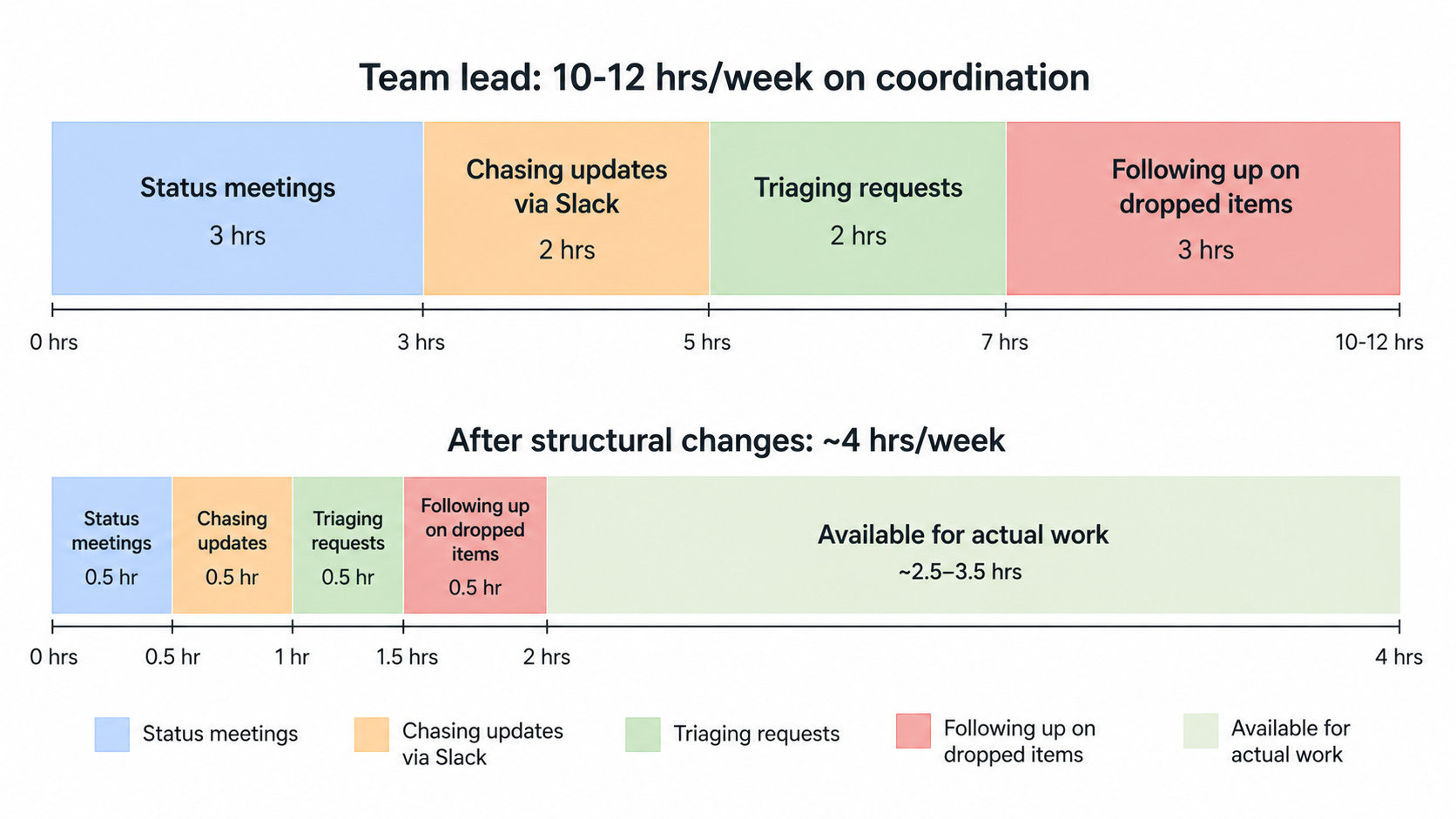
This case study follows a 7-person services team that cut coordination overhead by roughly 40% in 4 weeks — not by automating anything, but by structuring three things: intake, ownership, and review.
The team lead estimated spending 10–12 hours per week on coordination:
The team members experienced it differently: constant interruptions asking "what's the status on X?" and assignments that arrived verbally with no written record.
The result: a team that was busy but unpredictable. Deadlines were met through heroics, not systems.
Two root causes drove most of the coordination overhead:
Invisible work. Requests arrived via Slack, email, and meetings. Some were captured in a shared task board, but many lived only in someone's memory or message history. When something fell through, the discovery was always reactive — a client following up, a deadline passing silently.
Shared ownership. Tasks were assigned to "the team" or discussed in meetings without a single person taking explicit responsibility. When everyone owns it, nobody owns it — and the team lead became the de facto owner of everything by default.
All requests — from clients, internal stakeholders, and team members — entered one Inbox view. A simple form captured: title, requester, desired date, and a brief description.
The rule was absolute: if it's not in the Inbox, it doesn't get worked on. Slack messages and emails were still the communication channel, but the Inbox was the commitment system.
The team lead triaged the Inbox once daily (15 minutes). Each item became:
This single change eliminated the "did anyone see that email?" category of coordination.
Every project got one owner. Every task got one assignee. No exceptions.
This wasn't about removing collaboration — it was about removing ambiguity. The owner was the person responsible for knowing the current status, following up on blockers, and confirming completion. Others could contribute, but one person was accountable.
The hardest part was enforcing this culturally. "We'll all work on it" felt collaborative. "Sarah owns this" felt hierarchical. But within two weeks, the team realized that clear ownership actually reduced conflict — because expectations were explicit instead of assumed.
Every Friday, 30 minutes:
The review replaced the Monday standup. Instead of starting the week with a 45-minute conversation about what happened last week, the team started Monday with a clean, prioritized view.
No automations. No integrations. No dashboards. Three databases and three views: "This week" (tasks by assignee), "Active projects" (by owner), and "Inbox" (untriaged requests).
Because three maintenance views surfaced problems automatically:
The team lead stopped asking "what's the status?" because the status was visible. When something was stuck, the view showed it before anyone had to report it.
The team hired two people during the transition. Both were productive within a week because:
Before: deadlines were met because someone worked late to catch up on something that was discovered at the last minute.
After: deadlines were met because overdue items were surfaced 5 days before the deadline, not 5 hours.
The team didn't work fewer hours. They worked with fewer surprises.
The team didn't reduce manual work by automating it. They reduced it by making it unnecessary. Most "manual work" in small teams is actually coordination overhead caused by unclear ownership, invisible requests, and stale data.
Fix the structure, and the coordination overhead disappears on its own.
If you want to reduce coordination overhead without adding system complexity — explore how UniFrame structures this for small teams.


.jpg)
.jpg)