If you're looking for a real example of redesigning operations in Notion, the question that matters isn't "what tools did they use?" It's: what changed in how work actually moved through the company?
This case study follows a content agency with 12 people that consolidated five disconnected tools into one Notion-based system. The transformation wasn't about the tool. It was about making invisible work visible.
The agency had grown from 4 to 12 people in 18 months. The tools that worked at 4 didn't work at 12:
The real cost wasn't the tools themselves — it was the coordination overhead. Every status update required a meeting. Every handoff required a message. Every week, the founder spent 6+ hours just figuring out what everyone was working on.
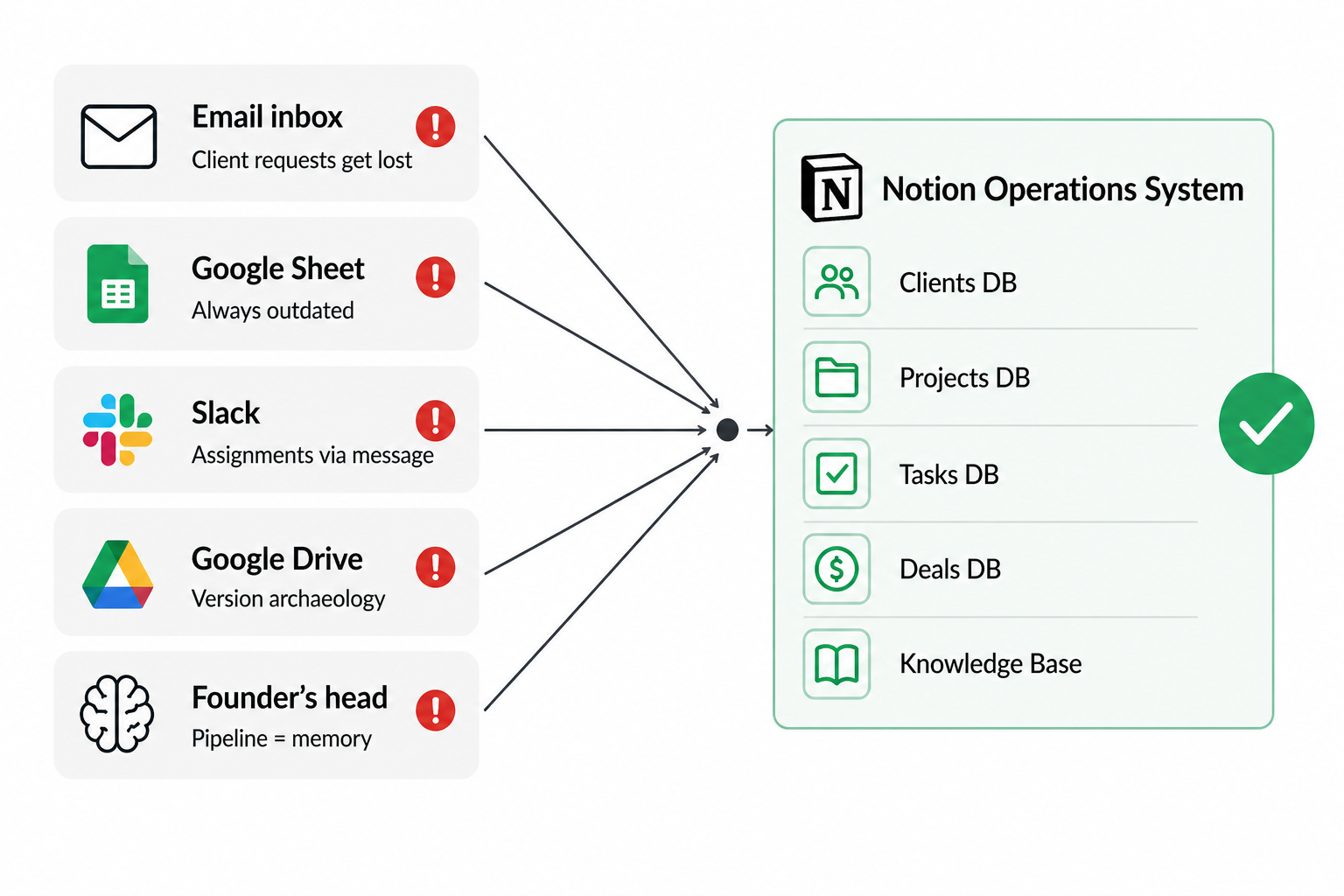
Before building anything, we identified the three gaps causing the most pain:
1. No intake system. Work arrived from too many channels. Roughly 30% of client requests were being handled without being formally tracked, which meant no visibility into workload or deadlines.
2. No ownership model. Projects had teams, not owners. "The design team is handling it" meant nobody specific was accountable for the outcome.
3. No review cadence. The only operational review was the Monday standup, which had become a 45-minute conversation where 12 people waited their turn to speak.
We deliberately avoided: Task → Client relations (reachable via Project), Deal → Project relations (a deal isn't a project until it's won), and any rollup that wasn't used in a weekly view.
Intake workflow: All client requests entered one Inbox view via a form. Required fields: client, description, desired deadline. The operations manager triaged the Inbox every morning — turning requests into tasks under existing projects, or flagging them for new project creation.
Execution workflow: The team worked from a single "This week" view grouped by assignee. Each person saw only their tasks for the current week. Project owners checked a "My projects" view showing active projects with open task counts.
Delivery workflow: Each project page contained a milestone checklist in the content and a linked view of remaining tasks. When all tasks were done and the deliverable was sent, the project moved to Done.
The team pushed back on the Inbox requirement. "Why can't I just handle the email directly?" The answer: you can handle it, but log it first. Within 3 days, the Inbox surfaced 4 client requests that would have fallen through cracks.
The Monday standup dropped from 45 minutes to 15. Instead of verbal updates, the founder opened three views: "This week" (tasks), "Active projects" (status), and "Inbox" (new requests). Questions became specific: "This task is overdue — what's blocking it?" instead of "What are you working on?"
With one owner per project (not a team), accountability shifted. The owner became the person who checked the task view, followed up on overdue items, and confirmed delivery. The founder stopped being the bottleneck for every status check.
The agency had two common deliverable types (blog packages and social media batches). Documenting the process for each as an SOP in the Knowledge Base meant new team members could follow the playbook instead of asking "how do we usually do this?"
After 4 weeks:
The biggest shift wasn't efficiency — it was trust. The team trusted the system because it reflected reality. The founder trusted the team because visibility replaced guesswork.
If you want to consolidate scattered tools into one operational system — book a call to discuss how this approach applies to your team.

.jpg)
.jpg)