If you're searching for how to structure your workflows step by step, you're probably dealing with a specific kind of chaos: work arrives from everywhere, priorities shift daily, and tasks don't translate into outcomes. People are busy, but nothing moves forward predictably.
The root cause is almost always the same: there's no defined flow from "someone needs something" to "it's done and closed." Clarity comes from building that flow explicitly — and running it weekly.
Most teams have tools. They have task lists, project boards, shared documents. What they don't have is a workflow — a defined sequence that moves work from request to completion with clear ownership at every step.
Without a workflow:
A workflow doesn't require complex automation. It requires four things: intake, prioritization, execution with constraints, and a review loop.
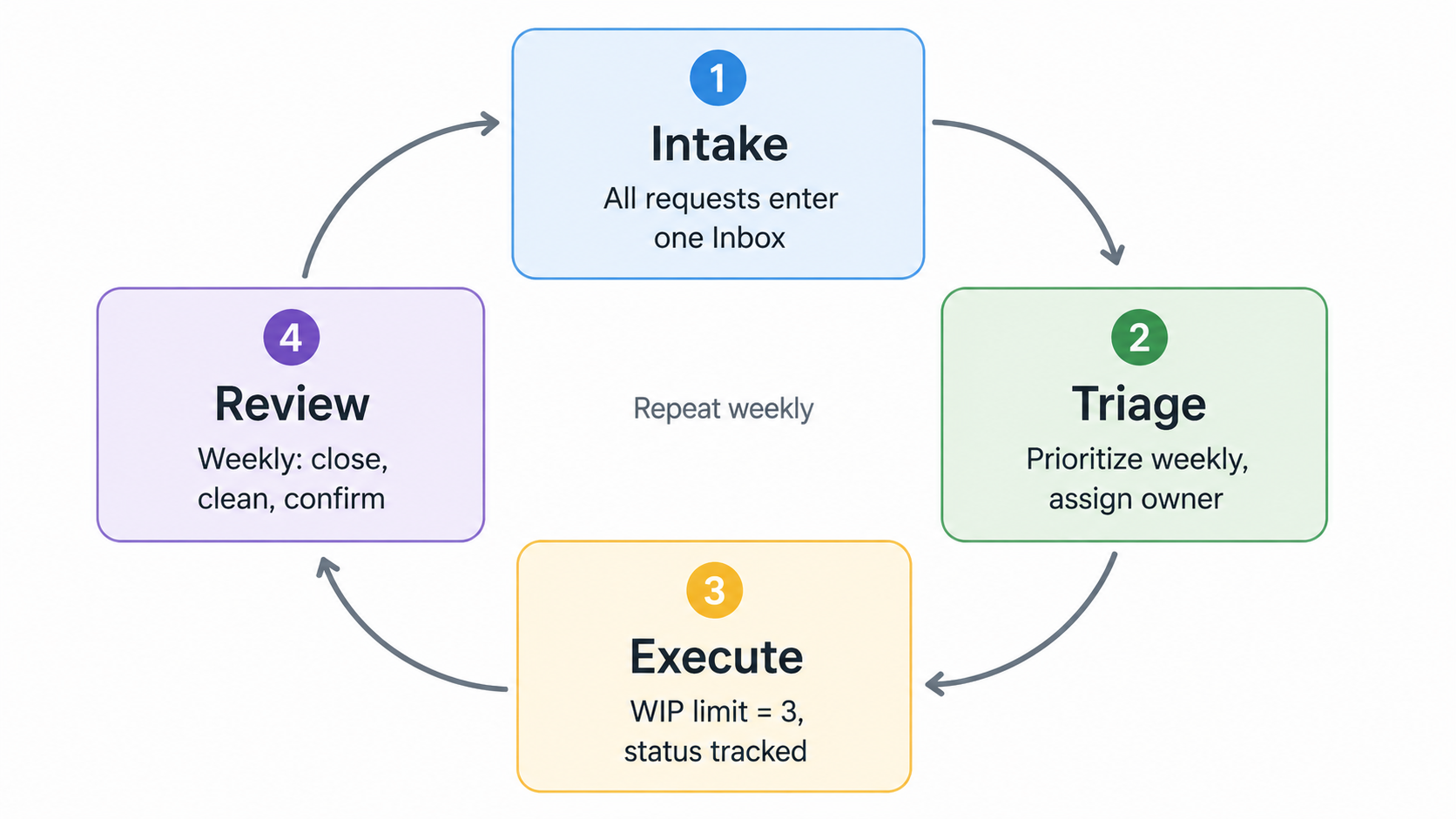
Before touching any database, write down how work actually flows in your team. Answer four questions:
If you can't answer these clearly, your team is running on improvisation. That works at 3 people. It breaks at 10.
Most workflow chaos starts with uncontrolled intake. Requests arrive from too many channels, and half of them bypass the system entirely.
The fix is one intake point:
The rule: if it's not in Inbox, it doesn't exist. This sounds rigid, but it's the only way to ensure nothing falls through cracks — and everything gets consciously prioritized instead of accidentally ignored.
This doesn't mean banning Slack messages or emails. It means those channels feed into one place. The message is the trigger; the Inbox item is the commitment.
Once work is captured, it needs to be ranked. The mistake most teams make is building a complex scoring system (Impact × Effort × Urgency × Strategic Alignment) that nobody maintains.
Simple options that actually get used:
The key insight: prioritization only works if it happens at a regular cadence (weekly triage), not in the moment when everything feels urgent.
A workflow breaks when everything is "in progress." If 20 tasks are marked "Doing," nothing is actually being done with focus.
The fix is work-in-progress limits:
When something new becomes urgent, something else must move back to "To do." This forces a real conversation about priority instead of pretending everything can happen simultaneously.
The secret to a clean workflow isn't discipline — it's visibility. Create views that automatically show what's broken:
These views replace the need for status meetings. Instead of asking "what's stuck?," you open the view. If it's empty, things are healthy. If it's full, you know exactly where to focus.
The weekly review is what keeps the entire workflow honest. Without it, every system decays within 2–3 weeks.
Weekly review agenda (30 minutes):
This 30-minute investment saves hours of ad-hoc coordination during the week.
A structured workflow doesn't make work easier — it makes work predictable. You know what's coming in, what's being worked on, what's stuck, and what's done. Surprises become the exception, not the norm.
The workflow itself is simple: Intake → Triage → Execute → Review. The power comes from running it consistently.
If you want a workflow that stays accurate with minimal overhead — explore how UniFrame builds this into every operational layer.


.jpg)
.jpg)